What set off the panic?
On 12 November, Jensen Huang stepped down as CEO of NVIDIA, the company he co-founded and led for 33 years. NVIDIA makes the chips that almost all of today's AI runs on, so this is huge news in the tech world. NVIDIA itself gave no reason. According to Reuters and Al Jazeera, he left after several days of intense scrutiny over his personal relationships. Colette Kress, the company's CFO, has been named interim CEO.
Reacting to the news, David Heinemeier Hansson (DHH), creator of the Ruby on Rails programming framework, posted a rather ominous message on X. Paraphrased: it might be worth backing up a few open-weight models and getting some basic hardware to run them. Nobody really knows what happened at NVIDIA, but the world has just lost one of free AI's biggest champions.
He has a point about the champion part. Huang had been one of the loudest voices for open-weight AI: in July he used his first post on X to publish an industry letter in support of open models, and NVIDIA releases its own open model family, Nemotron. TechCrunch was quick to ask whether that support survives his exit.
The phenomenon was summarised on X by Vincent (@vincent_ainotes). Building on his post, we look at what is going on and what it means for non-technical users, especially marketers.
AI survival kits on Reddit
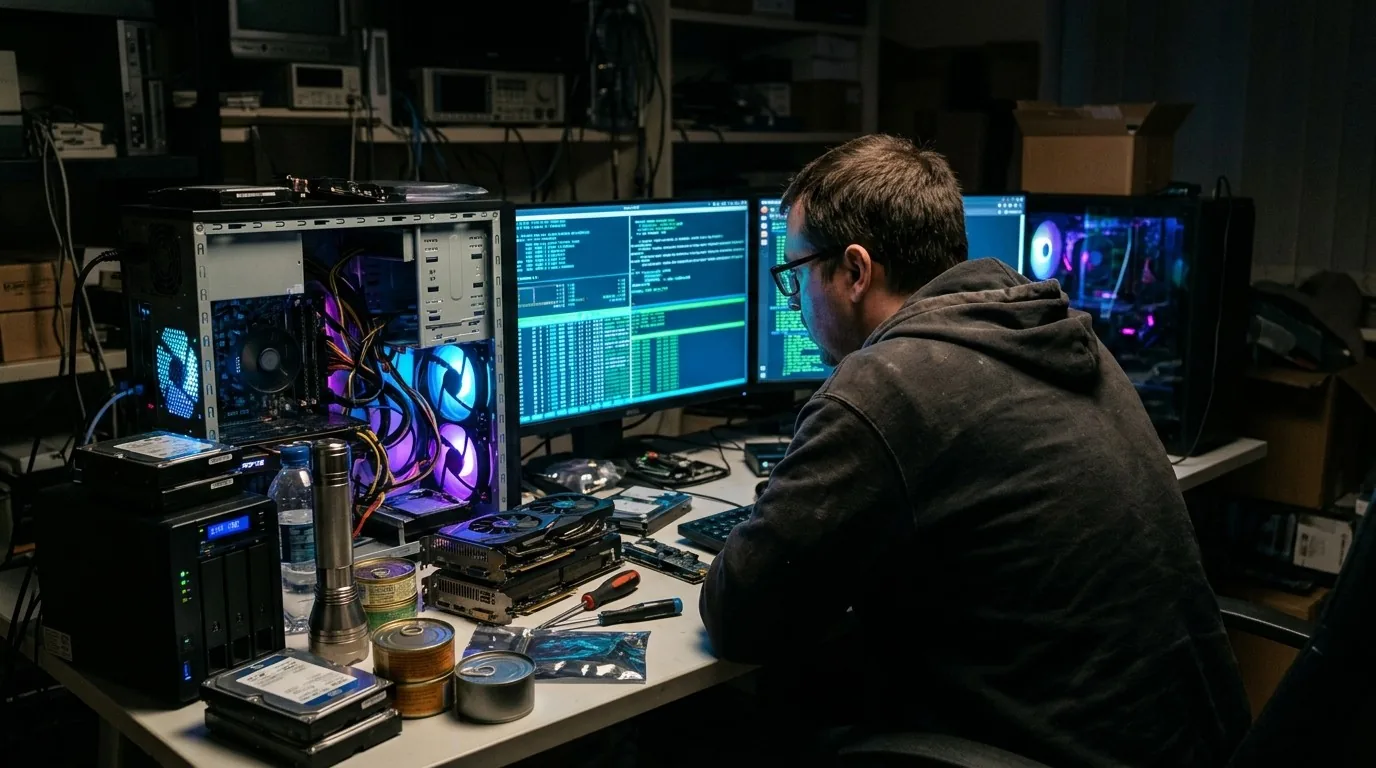
On Reddit, a serious discussion has started about what to save now in case open AI models one day stop being released. The comments quickly turned into a kind of doomsday-supplies show-and-tell. Vincent's summary picks out two of them.
Kahvana: the well-planned 2 TB kit. This user packed several model families (Qwen, Gemma, DeepSeek, Nemotron) onto a 2 terabyte SSD, each in several "compression levels". They did not stop at chat models either: there is speech recognition, text-to-speech, image generation, search-helper models and even a complete offline Wikipedia. The most important pieces are also copied to a home network storage box (NAS), together with the software needed to run them. In other words, they saved not just the tinned food but the tin opener too.
TheBigHODL: the 10.5 TB strategic reserve. This user has saved practically the entire line-up of well-known open models: Chinese (Kimi, DeepSeek, Qwen, GLM, MiniMax), American (Llama, OpenAI gpt-oss, Gemma) and European (Mistral). On top of that come speech and image models, training datasets, benchmarks, the whole of Wikipedia and a range of developer tools. This is no longer downloading a few files; it is archiving an entire self-contained AI workshop.
For scale: 10.5 TB is roughly 2,000 to 2,500 hours of Full HD film, or several million photos.
What is an "open-weight" model, and why save one?
ChatGPT, Claude and Gemini are cloud services: the model runs on the company's servers and we simply rent access. If the provider changes its prices, rules or terms, or shuts the service down, we have to adapt.
An open-weight model, by contrast, can be downloaded like a piece of software. The "weights" are essentially the model's brain: the enormous set of numbers it learned during training. Anyone who has that file can run it on a suitable machine in their own office, even without an internet connection.
An analogy: cloud AI is like Netflix, an open model is like a DVD on the shelf. Netflix is more convenient and always up to date, but a film can disappear from it at any time. The DVD is older, but it is yours.
The Reddit users' worry is simple: if Chinese models face tighter export or access restrictions, and American labs gradually stop releasing open weights, what you can freely download today from Hugging Face (the "YouTube" of AI models) may not be so easy to get tomorrow.
To be clear: for now this is the community's concern about the future. Washington has been weighing restrictions on Chinese AI models this year, but no such ban has been introduced.
What does this mean for a marketer?
There is no need to start buying hard drives tomorrow. The lesson, though, is very much a business one: today a lot of marketing teams build their daily work (copywriting, image creation, analysis, customer service replies) on a single external AI provider.
A few questions worth asking within your own team:
- What happens if our usual AI tool becomes more expensive or unavailable tomorrow? Do we have a plan B, or does content production grind to a halt? Price rises are not hypothetical: we covered what the AI pricing squeeze means for marketing budgets.
- Where do our prompts, templates and brand voice guidelines live? If only in a chat history, they are not really ours. It is worth keeping them in our own documents.
- What data are we handing over? Customer data, campaign results, internal strategy: with a locally run model, none of it ever leaves the business, which is also a plus from a GDPR point of view.
- Do we need the most powerful model for everything? Filling in a product description template or categorising text can often be handled perfectly well by a smaller model running locally.
The shift that is genuinely interesting
In the local AI community, people used to compete over who had more and faster graphics cards, and how quickly their machine could "talk". Now some are competing over who has the biggest hard drive, the most complete model collection, and who can still use AI with the internet switched off.
Old-school preppers stockpiled tinned food, diesel and generators. Today's AI enthusiasts stockpile models, computing power and offline knowledge bases.
It is easy to smile at, but it is not entirely unfounded. However powerful cloud AI is, your right to use it ultimately depends on the provider. A local model may be a few versions behind, but if you have the model, the software and the hardware, at least it is in your own hands.
- Jensen Huang's exit from NVIDIA has made part of the AI community nervous about the future of open-weight models.
- Some are saving entire model collections offline: one Reddit user has archived 10.5 TB.
- No ban exists today. The real lesson is about dependency: most marketing teams run on one AI provider.
- Keep your prompts and brand guidelines in your own documents, have a plan B, and use smaller local models where they are good enough.
As marketers, we do not need to build a survival bunker. We should, however, decide consciously how dependent we want to be on a single provider. At Trendfingers, we are happy to help you map where your team uses AI and where a fallback option makes sense. Get in touch.